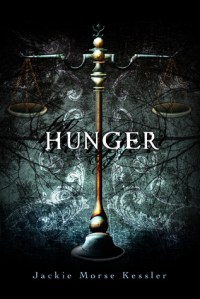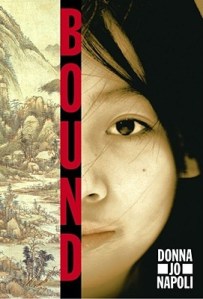
Book Review: Bound by Donna Jo Napoli

Bound Napoli CoverBook: Bound by Donna Jo Napoli

Published November 2004 by Atheneum|184 pages

Where I Got It: I borrowed the hardcover from the library

Series: None

Genre: YA Historical Fiction/Fairy Tale Re-Telling
Blog Graphic-What It's About

Young Xing Xing is bound.  Bound to her father’s second wife and daughter after Xing Xing’s father has passed away. Bound to a life of servitude as a young girl in ancient China, where the life of a woman is valued less than that of livestock. Bound to be alone and unmarried, with no parents to arrange for a suitable husband. Dubbed “Lazy One” by her stepmother, Xing Xing spends her days taking care of her half sister, Wei Ping, who cannot walk because of her foot bindings, the painful but compulsory tradition for girls who are fit to be married. Even so, Xing Xing is content, for now, to practice her gift for poetry and calligraphy, to tend to the mysterious but beautiful carp in her garden, and to dream of a life unbound by the laws of family and society.

But all of this is about to change as the time for the village’s annual festival draws near, and Stepmother, who has spent nearly all of the family’s money, grows desperate to find a husband for Wei Ping. Xing Xing soon realizes that this greed and desperation may threaten not only her memories of the past, but also her dreams for the future.

In this searing story, Donna Jo Napoli, acclaimed author of “Beast and Breath,” delves into the roots of the Cinderella myth and unearths a tale as powerful as it is familiar.
Blog Graphic- What I Thought

I really like fairy tale re-tellings, and I was really intrigued by a Chinese re-telling of Cinderella.  Especially because I loved Cinder.  I liked it, but not as much as I liked Cinder.  However, if you want something a little more historical, and a little less dystopic, this is definitely a good book to check out.

It seems like it’s a pretty straightforward re-telling of Cinderella, and I like that it’s pretty similar to one of the Chinese variations on the Cinderella story.  I do wish the author had deviated from the original story a little more, just because I would have liked to see her do something different with her re-telling of Cinderella.  It’s very clear that it’s a Cinderella re-telling, which I liked, but…I still wanted something slightly different, because if I wanted something that mirrored the original pretty closely, I’d go read the original.

Because of the setting, it’s a slightly different take on the Cinderella story we’re familiar with, partly because of Disney and partly because of the different Roger’s & Hammerstein versions out there (of which the Whitney Houston one is my favorite, but probably because it’s the only one I’ve seen, not counting the Disney version).  It seems like there are more variations on the Cinderella story across different time periods and continents that any other fairy tale out there, and this episode of The History Chicks does a great job at going over all of the different variations.

Blog Graphic- My Rating

3 stars.  It’s a pretty straightforward re-telling of one of the many variations of the Cinderella story, and I love the setting.  I like that it re-tells a version most Americans probably aren’t familiar with, but at the same time, I wanted some sort of twist on the story we all know.

Book Review: The House On Mango Street by Sandra Cisneros

The House On Mango Street CoverBook: The House Of Mango Street by Sandra Cisneros

Published April 1991 (originally published 1984) by Vintage|110 pages

Where I Got It: I borrowed the paperback from the library

Series: None

Genre: Adult Fiction

Blog Graphic-What It's About

Told in a series of vignettes stunning for their eloquence, The House on Mango Street is Sandra Cisneros’s greatly admired novel of a young girl growing up in the Latino section of Chicago. Acclaimed by critics, beloved by children, their parents and grandparents, taught everywhere from inner-city grade schools to universities across the country, and translated all over the world, it has entered the canon of coming-of-age classics.

Sometimes heartbreaking, sometimes deeply joyous, The House on Mango Street tells the story of Esperanza Cordero, whose neighborhood is one of harsh realities and harsh beauty. Esperanza doesn’t want to belong–not to her rundown neighborhood, and not to the low expectations the world has for her. Esperanza’s story is that of a young girl coming into her power, and inventing for herself what she will become. 

Blog Graphic- What I Thought

Like Things Fall Apart, The House On Mango Street was a book I had to read in high school, and even though I sort of remembered the story, there was a lot I had forgotten since then.  I don’t remember how I felt about it when I read it in high school- I’m pretty sure it wasn’t one of the few books I had to read and ended up liking, but as an adult, I really liked it.

I really liked how we get these snapshots of Esperanza’s life over the course of a year.  You get such a good glimpse of what her neighborhood is like, and the expectations that the world has for her.  You see how she wants to break out of that, and how she wants more for herself, even though the people around her might not expect it, or even encourage it.  There were a couple points- some unwelcome kisses and when one of her neighbors gets married- where there could be more to it, but you could also just take it as it was written.

It definitely broke my heart at times, but there were also times where I really felt for Esperanza, and I finished the book feeling confident that things would work out in her favor.  It reminded me of my own childhood, and how different things are now for kids.  There is something timeless about this book, and even though it was published just over 30 years ago, it holds up really well.  It’s still relevant, and totally worth reading, if you haven’t read it.  It’s even worth re-reading as an adult, and I’m actually glad I happened to see it at the library.

Blog Graphic- My Rating

4 stars.  I didn’t quite love it, just because I wanted to live in Esperanza’s world for a little bit longer, but overall, I’m really glad I picked it up and read it.

Book Review: Some Like It Wicked by Teresa Medeiros
Some Like It Wicked CoverBook: Some Like It Wicked by Teresa Medeiros

Published by July 2008 by Avon|384 pages

Where I Got It: I borrowed the paperback from the library

Series: Kincaid Highland #1

Genre: Adult Romance/Historical Romance

Blog Graphic-What It's About

Some like it dangerous . . .

Highland beauty Catriona Kincaid cares nothing for propriety—or even her own safety—when she storms the grounds of Newgate Prison. Determined to return to Scotland and restore her clan’s honor, she seeks the help of Sir Simon Wescott, a disgraced nobleman and notorious rogue. She is prepared to offer him both wealth and freedom, but she never dreams the wicked rake will be bold enough to demand a far more sensual prize.

Some like it seductive . . .

Simon is shocked to discover the tomboy he met long ago has blossomed into a headstrong temptress. Although he’s sworn off his dreams of becoming a hero, he can’t resist playing knight errant to Catriona’s damsel in distress. Both adventure and peril await them at her Highland home, where they will risk their lives to vanquish her enemies . . . and risk their hearts to discover a passion beyond their wildest dreams.

Blog Graphic- What I Thought

Romance is one of those genres I always tell myself I’m going to read more of, and yet, it’s one of those genres I never seem to read a lot of.  Which is weird, because, for the most part, I’ve really liked a lot of the romances I’ve read. Sadly, this wasn’t the case for Some Like It Wicked, which turned out to be okay for me.

Catriona definitely is what I’d call strong.  She’s very determined to make sure the family name and the family land is okay, and she’s willing to do what she has to in order to get it back.  She was naive about some things (particularly in regards to Simon), but everything worked out in the end, and it wasn’t actually annoying.  In fact, it made sense for Catriona herself.  She wasn’t as wild and independent as I thought she’d be, but she did seem to be pretty independent by the end of the book.

And Simon…what can I say about Simon?  He definitely redeemed himself by the end of the book, and I actually liked Simon a lot more than I thought, especially where Cat was concerned.

But them together?  I liked them together, but only a little.  They certainly balance each other out, but I didn’t quite feel them as a couple.  They definitely had chemistry, and I wanted to love them together, but I just didn’t.

And it wasn’t as focused on romance as I thought it would be.  It was definitely there, but it felt like it was more about Catriona saving her family than anything else.  It ended super-happy- which is fine, and I pretty much expected that- but…I don’t know, I just wasn’t enthused with the super-happy ending.

Blog Graphic- My Rating

2 stars.  I don’t have much to say about Some Like It Wicked.  I get why people really like it/love it but it’s not one of my favorites.  I’d definitely give another one of her books a try, but not anytime soon.

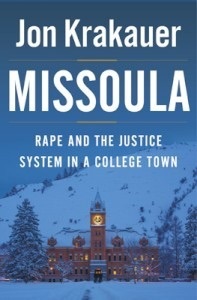
Book Review: Missoula: Rape And Injustice In A College Town by Jon Krakauer
Missoula CoverBook: Missoula: Rape And Injustice In A College Town by Jon Krakauer

Published April 2015 by Doubleday|349 pages

Where I Got It: I borrowed the hardcover from the library

Series: None

Genre: Adult Non-Fiction

Blog Graphic-What It's About

Missoula, Montana is a typical college town, home to a highly regarded state university whose beloved football team inspires a passionately loyal fan base. Between January 2008 and May 2012, hundreds of students reported sexual assaults to the local police. Few of the cases were properly handled by either the university or local authorities. In this, Missoula is also typical.

In these pages, acclaimed journalist Jon Krakauer investigates a spate of campus rapes that occurred in Missoula over a four-year period. Taking the town as a case study for a crime that is sadly prevalent throughout the nation, Krakauer documents the experiences of five victims: their fear and self-doubt in the aftermath; the skepticism directed at them by police, prosecutors, and the public; their bravery in pushing forward and what it cost them. These stories cut through abstract ideological debate about acquaintance rape to demonstrate that it does not happen because women are sending mixed signals or seeking attention. They are victims of a terrible crime, deserving of fairness from our justice system. Rigorously researched, rendered in incisive prose, Missoula stands as an essential call to action.  

Blog Graphic- What I Thought

Missoula was a book I heard about last year, and finally picked up this year.  It’s also a book that I’ve put off reviewing, because how do you talk about a book like Missoula?

I got so angry when reading it, and for me, the first 100 pages or so, were really hard to read.  How people listen to it on audio, I don’t know, because I had a hard enough time reading it, much less listening to it.  Still, the graphic descriptions of rape are almost clinical, but it is something to keep in mind if you pick up this book.

I thought the first half of the book was a lot stronger than the second half, just because the second half of the book is a lot of court transcripts, and those, I ended up skimming over.  And I can’t say that I was surprised by how the victims were treated, and that the district attorney’s office decided not to go forward with prosecuting many cases, even when they had reason to, because I wasn’t.  And Kirten Pabst, one of the District Attorneys…her actions were completely horrible, and I was completely horrified by her actions, and that she would go on to be elected District Attorney.

Missoula is an important book, though, and one everyone should read.  There are a lot of small details in the book, and I felt like Krakauer put a lot of work and research into the book.  If you know anything at all about how rape is handled in the U.S., this book might not reveal anything new, but the stories surrounding the women in this book were very moving, and if it opens someone’s eyes and sparks even a few conversations, then I think it’s worth it.

Blog Graphic- My Rating

4 stars.  It was moving and hard to read, but the court transcripts were a little dry and ended up being something I skimmed.  Still, I think it’s a book everyone needs to read, because it deals with a crime that is under reported, and where victims are blamed for what they went through.

Book Review: Things Fall Apart by Chinua Achebe

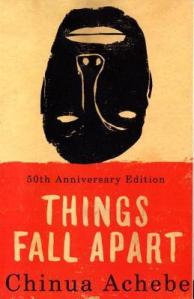
Things Fall Apart CoverBook: Things Fall Apart by Chinua Achebe
Published October 2010 (but originally published in 1958) by Anchor|224 pages

Where I Got It: I borrowed the e-book from the library

Series: The African Trilogy #1

Genre: Adult Fiction

Blog Graphic-What It's About

Things Fall Apart tells two intertwining stories, both centering on Okonkwo, a “strong man” of an Ibo village in Nigeria. The first, a powerful fable of the immemorial conflict between the individual and society, traces Okonkwo’s fall from grace with the tribal world. The second, as modern as the first is ancient, concerns the clash of cultures and the destruction of Okonkwo’s world with the arrival of aggressive European missionaries. These perfectly harmonized twin dramas are informed by an awareness capable of encompassing at once the life of nature, human history, and the mysterious compulsions of the soul.

Blog Graphic- What I Thought

Things Fall Apart was a book I was required to read back in high school, and I randomly decided to pick it up and read it again.  Even though I didn’t love it, I liked it more than I thought I would- and I definitely liked it a lot more as an adult than I did as a high school student.

I really liked seeing Okonkwo’s fall from grace, and how it was so tied to the change of the world that he knew. What your family did was really important (especially to Okonkwo), and he worked really hard for the success he had.  He didn’t want to be like his father, and he didn’t want his father’s life for his children, which I think is something we can all relate to in some way.

The writing was really simple, but in a good way.  It was very straightforward, and I really liked that, because I felt like Achebe got right to the point.  You really see how much European missionaries changed things, and I couldn’t help but wonder how much we’ve lost because of colonization.

Part of why I didn’t love it was because it was depressing.  Which makes sense, given everything Okonkwo experienced and went through, and all of the change that happened.  Okonkwo does have a code that he lives by, and even though I understand why he acts the way he does…it doesn’t mean it’s okay, but I do get it.  At the same time, though, he really must have felt like he was out of options.  And when you think about it in the context of colonization, and how people must have felt, knowing they probably had to assimilate, or else…I really felt for them, because things were fine, until they weren’t.

I did like that you saw how some of the British who came took into account their traditions and customs, and how some didn’t.  You also saw that some of the people from Okonkwo’s village welcomed the missionaries, and how others didn’t.  It was very much shades of grey in this book, and I liked that it was fairly neutral.

Blog Graphic- My Rating

3 stars.  I’m not sure what else to say about Things Fall Apart.  I definitely recommend it, because I think it’s an important story.  And I definitely appreciate it a lot more as an adult than I ever did in high school.

Book Review: Wonder by R.J. Palacio

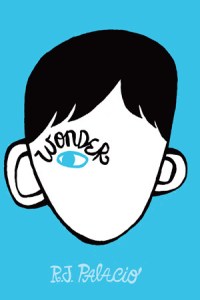
Wonder CoverBook: Wonder by R.J. Palacio

Published February 2012 by Knopf|320 pages

Where I Got It: I borrowed the hardcover from the library

Series: Wonder #1

Genre: Middle Grade Contemporary

Blog Graphic-What It's About

I won’t describe what I look like. Whatever you’re thinking, it’s probably worse.

August (Auggie) Pullman was born with a facial deformity that prevented him from going to a mainstream school—until now. He’s about to start 5th grade at Beecher Prep, and if you’ve ever been the new kid then you know how hard that can be. The thing is Auggie’s just an ordinary kid, with an extraordinary face. But can he convince his new classmates that he’s just like them, despite appearances?

R. J. Palacio has written a spare, warm, uplifting story that will have readers laughing one minute and wiping away tears the next. With wonderfully realistic family interactions (flawed, but loving), lively school scenes, and short chapters, Wonder is accessible to readers of all levels.

Blog Graphic- What I Thought

Wonder is one of those books I’ve heard a lot about, and knew that people really loved, but never got around to reading until now.  I liked Wonder, but not as much as I thought I would.

I really liked the family dynamic, and I really felt for his sister Via.  We don’t get a lot of her, but we see how the attention Auggie gets affects her, and I really liked seeing that.  I’m not sure if I could have handled an entire book from her perspective, but I did like the small bit that we do get in the book.

I also liked how real the characters felt.  How they acted- what with The Plague thing, and the stares and stuff, I can see that happening in real life.  How one of the moms acted was horrible- she photoshopped Auggie out of the class photo, and acted like he didn’t belong in school, just because of how he looks.  And it was really hard to read, because, theoretically, she should know better.  But clearly not, and it makes me wonder if her son acted the way he did because he learned it from her.  In the end, the other kids ended up being pretty okay, except for the one.

There is something I have mixed feelings about, though, and that’s Auggie himself.  I liked that he sees himself as a normal kid, and that he’s not special or extraordinary, just because of how he looks, even though people around him probably think he’s special because of how much he accomplished, and all of the surgeries he’s had to endure.  On the one hand, I liked that the book mentioned the fact that he was born with a cleft palate, which led to a lot of other health issues for Auggie, but didn’t focus too much on it.  But at the same time, I wanted a little more about it, because the book hardly goes into it.

Another issue I had was the fact that the characters seemed a lot older than 10.  The way they talked and acted…it didn’t mesh well with the fact that it’s middle grade.  It was really disorienting, and if 10 year-olds are, in real life, dating the way some of them seem to be dating in this book, I’m a little worried.

The book was also super-positive, which I get, considering the target audience, but it made the book feel too perfect, like nothing gets to Auggie (even though it must), and that everything will work out just fine, no matter what.  It felt too simple, for something that could have had even a little more complexity to it.  It’s not for me to say that Auggie is too well-adjusted, because I’ve never experienced what Auggie has, and I have no idea what it’s like to be in his position.  But it was also something that was a little off-putting, just because I wanted something that seemed a little more realistic.

Blog Graphic- My Rating

3 stars.  I get why people loved this book so much, and I do like the message of not judging people because of how they look, and that you should be kind to people.  But it was too simple, and too perfect, and I wanted something a little more complex and something that was a little less perfect.

Book Review: Hunger by Jackie Morse Kessler

Hunger CoverBook: Hunger by Jackie Morse Kessler

Published October 2010 by Harcourt Graphia|177 pages

Where I Got It: I borrowed the paperback from the library

Series: Riders Of The Apocalypse #1

Genre: YA

Blog Graphic-What It's About

“Thou art the Black Rider. Go thee out unto the world.”

Lisabeth Lewis has a black steed, a set of scales, and a new job: she’s been appointed Famine. How will an anorexic seventeen-year-old girl from the suburbs fare as one of the Four Horsemen of the Apocalypse?

Traveling the world on her steed gives Lisa freedom from her troubles at home: her constant battle with hunger, and her struggle to hide it from the people who care about her. But being Famine forces her to go places where hunger is a painful part of everyday life, and to face the horrifying effects of her phenomenal power. Can Lisa find a way to harness that power — and the courage to battle her own inner demons?

Blog Graphic- What I Thought

So…I really like the idea of an anorexic 17-year-old as Famine, but the actual book?  Not so much.  I wanted to like it a lot more than I did.

Let’s start with what I did like about Hunger.  I really liked the scenes where we see Lisa struggle with her weight and the hold that her Thin voice has on her.  I also found myself liking some of the scenes at the end, where Lisa is Famine, and what it’s like to be in other parts of the world.  With this book, you really are in the mindset of someone who is anorexic, and the book does a really great job at showing that.

But the Famine and Four Horsemen of the Apocalypse elements?  Those didn’t work for me at all…mostly because they didn’t make a lot of sense.

So, it seems like Lisa had to become Famine in exchange for Death letting her live, but that just left me with so many questions.  Is that how it works for all of the Horsemen, or just Lisa?  And if that’s how one becomes one of the Horsemen of the Apocalypse, then how would it work if Death dies?  Lisa has trouble deciding if she wants to live or die, and kind-of-sort-of-but-not-really accepts the post of Famine, and then decides she doesn’t want it, and everything is magically okay because she’s seen how horrible it is that some people have to go without food, and so she decides she needs help with her eating disorder…it is an interesting idea, and it is a different way to show what it might be like to be anorexic.  But to just reject it and go back to her own life, like nothing’s happened?  I wanted from the Four Horsemen Of The Apocalypse thing.

Because, honestly?  I’m not completely sure what the point of that arc was.  Is it really bringing about the apocalypse, or is it just a tool to highlight different issues people struggle with?  I couldn’t get a sense of the overall purpose of the series with this book, and I really think the book needed more about it, because it definitely felt like something was missing as far as that goes.

And even though the scenes where we see Lisa struggle with anorexia were done really well, something about it felt really cold and clinical to me.  Only one person seemed to pick up on the fact that something was going on with Lisa, and it wasn’t until she said something about it that anything actually happened.  I wish we saw more of Lisa, and the story behind why she became anorexic.

Blog Graphic- My Rating

2 stars, just because I think the idea of Famine as a 17-year-old anorexic is a really interesting concept. I think the Horsemen Of The Apocalypse aspect could have been done better (and it was sort of confusing and not explained well), and Lisa as an anorexic could have been less cold.

Book Review: Parable Of The Sower by Octavia Butler
Parable Of The Sower CoverBook: Parable Of The Sower by Octavia Butler

Published November 1993 by Four Walls Eight Windows|299 pages

Where I Got It: I borrowed the hardcover from the library

Series: Earthseed #1

Genre: Adult Dystopia/Apocalyptic

Blog Graphic-What It's About

When unattended environmental and economic crises lead to social chaos, not even gated communities are safe. In a night of fire and death Lauren Olamina, a minister’s young daughter, loses her family and home and ventures out into the unprotected American landscape. But what begins as a flight for survival soon leads to something much more: a startling vision of human destiny… and the birth of a new faith.

Blog Graphic- What I Thought

Lately, I’ve been on an Octavia Butler kick, and while I have yet to read Kindred, I will get to it at some point.  I really liked Fledgling and Wild Seed but I didn’t like Parable Of The Sower as much as I thought I would.  I liked it, but not as much as I expected to.

Parable Of The Sower felt really dense, and I could only read it a few chapters at time before I had to put it down. It felt really slow, which does make sense, given it takes place over the span of several years.  And it’s in sort of a diary-format, which was fine, but I think that’s why it felt so slow to me.  Considering everything is falling apart, I was surprised that things moved so slow.

I did like seeing the community that Lauren wanted to build, especially in the world she’s living.  It’s only ten years from now, when the book takes place, so as far as time goes, it’s not too far off from where we are now. And I can picture a world where communities are nervous about new-comers or people passing through, and in some areas, being walled off.  And people stealing and starting fires because of a new drug out there (which I think was initially to cure Alzheimer’s that had some really bad effects), and water shortages….the water shortage is all too familiar to me, living in San Diego, so I can picture parts of the book really well.

Still, we are put in this world, where jobs are hard to find (also sort of familiar, in a general sense) and people are in debt to the point that debt slavery is a thing.  And I wish we had more context for what happened to U.S.  I got the general idea, but I kind of wanted more specifics about how the world Lauren lives in got to that point.

And in a weird way, I was reminded of Station Eleven by Emily St. John Mandel.  Partly because of the fact that the book takes place over a long span of time, but also because things are unraveling/have unraveled, and that there are small pockets of people banding together, and the time spent on the open road.  Other than that, I’m not quite sure why I thought of Station Eleven, but it could be an interesting read-alike for Parable Of The Sower.

There is a lot about gender, class and race in the book, and what it’s like for a California that’s set in the near-distant future.  I think that’s pretty typical for Butler’s work, if the other books I’ve read by her are any indication.  But I like that she does that, because it doesn’t seem to happen a lot.  Then again, maybe I’m just not reading a lot of books where it comes up (but I am trying to make more of an effort to do that).

I’m not sure how I feel about Lauren having hyper empathy, or able to feel other people’s pain/pleasure.  It seemed a little confusing, and how it affected her seemed randomly put in, and sort of distracting.  Like, how can she bike around, and not be affected by other people?  Or, how can she kill, but not die herself?  And, why/how did she outgrow bleeding when other people did, but not outgrow pain?  It seemed a little out of place in this world, and the only explanation we get for why she is that way is because her mom was a drug user.  It was actually kind of disappointing, especially after reading both Fledgling and Wild Seed.

I think it’s time to talk Earthseed itself.  I get Lauren created it herself, and she didn’t share her father’s religious beliefs.  A lot of people don’t, and that’s fine.  But it seemed more like a philosophy than an actual religion, but maybe that’s because it’s not really set up as an actual religion with followers in this book.  The Earthseed stuff wasn’t as interesting as I thought it would be, and I ended up skipping over all of Lauren’s Earthseed writings.  I get why she wanted a community, especially in the world she’s living in, but it didn’t really pay-off in this book.

Blog Graphic- My Rating

3 stars.  Parable Of The Sower felt really dense, and Earthseed itself was really uninteresting to me.  I just had a really hard time getting into it, but it could be an interesting read-alike for Station Eleven.

Book Talk: The BFG, A Movie And Book Review

Book Talk is a sporadic feature where I talk about non-book review but bookish things…and today’s post is all about The BFG!

Book Talk

And as a warning, there are some spoilers for both the movie and the book!

The Movie:

I saw The BFG a few days ago, because it looked awesome in the trailers, and I remember reading Roald Dahl as a kid, so I knew I had to go see this movie adaptation.  Sadly, I couldn’t remember if this was one of the books I read by Dahl as a kid, because the movie didn’t jog any memories of reading the book.  So either I never read it or I read it but don’t remember reading it.  Either way, it was new to me.

I loved it as a movie, and even though I’m not a big fan of 3D, it was totally worth it in 3D.  I’m serious, guys, it worked really well in 3D.  Things weren’t jumping out at you, but there was a lot more scale and perspective and I felt a lot more like I was actually in the movie, and I don’t know that you would have had that experience in the non-3D version.  Maybe you would have but not to the same degree.  But I really felt like we were immersed in Giant Country.  And I’m not going to lie, I cried at the end.  I loved the movie, especially the scene where Sophie and the BFG go to catch dreams.  It looked really pretty, and I wish we saw the actual dreams just going around. But I also liked that they were balls of light.  And I really liked how his house looked!  It was just really pretty to watch.

With the BFG himself, you see how small everything is in comparison to him, and that’s partly why I liked it. You felt small, but in a good way.  And in comparison to the other giants, you see that he’s really not that big himself. Overall, it was just really pretty to see, and I definitely recommend seeing it theaters if you can.  As it is, I don’t know that it will be in theaters for very long, because it seems like there aren’t a lot of showings of it…

I also really liked it as an adaptation!  With any adaptation, there were some changes, but overall, it followed the book pretty closely.  I really wish we saw the dreams, especially since there are dreams described in the book.  I know I already kind of mentioned that, with when they go to catch the dreams, but seeing the dreams would have been really cool.

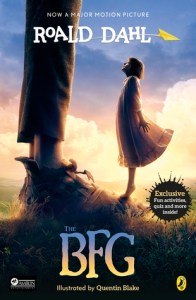
The BFG CoverThe Book: The BFG by Roald Dahl, illustrated by Quentin Blake

Originally published in 1982 by Farrar, Straus & Giroux|224 pages

Where I Got It: I own the e-book

Series: None

Genre: Children’s Fantasy

What It’s About: Captured by a giant! The BFG is no ordinary bone-crunching giant. He is far too nice and jumbly. It’s lucky for Sophie that he is. Had she been carried off in the middle of the night by the Bloodbottler, the Fleshlumpeater, the Bonecruncher, or any of the other giants-rather than the BFG-she would have soon become breakfast.

When Sophie hears that they are flush-bunking off in England to swollomp a few nice little chiddlers, she decides she must stop them once and for all. And the BFG is going to help her!

What I Thought: I really liked it!  It’s such a cute story, and even though it’s one of the Roald Dahl books I never read as kid, I’m glad I finally got to read it.  I remember liking some of his other books, and it’s such an imaginative one.  I will say that some of the gifts described at the end of the book were stereotypical, and that bothered me. And for some reason, the book didn’t seem as magical as the movie did, which makes me hesitant to re-read some of Dahl’s other books, because I feel like the magic and creativity of his books might not have the same effect on me as an adult as they did when I was a kid.  It makes me wonder if maybe I’m too old for Roald Dahl, which makes me a little sad, because generally, I don’t think you’re too old to read anything.  But in this case?  Maybe it’s possible.  I’d still recommend it as a book, because I really like the overall creativity and the conversation that the BFG has with Sophie about how giants don’t kill each other, and how kind the BFG is to Sophie.

My Rating: 4 stars.  I really like the story, but it wasn’t as magical as I thought it would be.

Book Review: Six Of Crows by Leigh Bardugo

Six Of Crows CoverBook: Six Of Crows by Leigh Bardugo

Published September 2015 by Henry Holt & Company|465 pages

Where I Got It: I borrowed the hardcover from the library

Series: Six Of Crows #1

Genre: YA Fantasy

Blog Graphic-What It's About

Ketterdam: a bustling hub of international trade where anything can be had for the right price—and no one knows that better than criminal prodigy Kaz Brekker. Kaz is offered a chance at a deadly heist that could make him rich beyond his wildest dreams. But he can’t pull it off alone…

A convict with a thirst for revenge.

A sharpshooter who can’t walk away from a wager.

A runaway with a privileged past.

A spy known as the Wraith.

A Heartrender using her magic to survive the slums.

A thief with a gift for unlikely escapes.

Kaz’s crew are the only ones who might stand between the world and destruction—if they don’t kill each other first.

Blog Graphic- What I Thought

I really liked Six Of Crows!  It was nice to visit the world we got to know in her Grisha trilogy, and revisit it in a completely different way.

I liked seeing a completely different part of Ravka, and how this group of people came together for one task.  It’s a random assortment of people, but they all brought something different to the group, and they all have such different skill sets.  It made everyone important, and I thought they worked really well as a group.

I also liked seeing everyone’s stories, and how they ended up in Ketterdam.  We all learn more about the different characters, and how they came to be involved in this really big heist.  And they all take turns narrating, which I really liked.  It was a little slow at first, and hard to get into, because it takes a little bit to figure out who is who, and what their story was, and their place in this world, but once you get past that, it was an interesting read.

It’s such a complex world, and it takes place after the Grisha trilogy ends (though how long after, I’m not sure). Like I said earlier, you get a different look at this world, because of the different setting, and it really expands on how people see the Grisha, and how things are in a different place.  With spin-off series, I get a little nervous, just because I never know if I’ll like it as much as the original.  More often than not, I do, but in this case, I think setting it in the same universe, but in a different setting, and at a later point on the timeline, was a really good idea, because you still get a sense of the world and it’s familiar but also different.

I think what I love the most was that the heist didn’t go as planned.  It definitely changed how Kaz went about trying to get them out of it, and I really am curious as to how the rest of the series is going to go.  There’s romance (which has a small part in things and totally threw me for a loop) and adventure and even though I didn’t love it, I still thought it was a really great book.  There’s more to this world than I ever thought was possible in the original series. And what’s nice is that you don’t need to read the Grisha trilogy to know what’s going on in this book, because even though they’re set in the same world, they’re also stand-alone series.  I don’t know if that makes sense, but I don’t know how else to explain it.  You can, of course, and some of the terminology and magic might make more sense, but it’s not necessary because Bardugo does a great job at explaining how this world is.

Blog Graphic- My Rating

4 stars.  It was a little slow at first, but it definitely lives up to the hype!