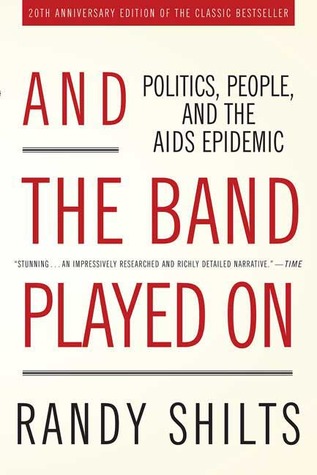
 Book: And The Band Played On by Randy Shilts
Published November 1987 by St. Martin’s Press
How I Got It: Purchased the paperback, 630 pages
Genre: Non-fiction: GLBT/Medicine/Sociology/Politics
Find out more: Goodreads|Barnes And Noble|Amazon
Goodreads.com Summary: Upon it’s first publication twenty years ago, And The Band Played on was quickly recognized as a masterpiece of investigatve reporting. An international bestseller, a nominee for the National Book Critics Circle Award, and made into a critically acclaimed movie, Shilts’ expose revealed why AIDS was allowed to spread unchecked during the early 80’s while the most trusted institutions ignored or denied the threat. One of the few true modern classics, it changed and framed how AIDS was discussed in the following years. Now republished in a special 20th Anniversary edition, And the Band Played On remains one of the essential books of our time.
I am so glad I read And The Band Played On! I watched the movie in health class in high school, and completely forgot about it until it showed up as a recommendation through Goodreads.
It’s was a great read, especially because most of the events in the book took place before I was born. I know what AIDS is like now, but I had no idea what it was like when AIDS first started showing up in people. Reading
One thing I really liked was the day-to-day unfolding of AIDS. You see what it was like for so many people- the people who had AIDS, their friends and family and the doctors and scientists. It worked especially well at the beginning, when everyone was trying to figure out what AIDS was. It did get a little tiresome at times and sometimes, it was hard getting through some of the sections that dealt with funding and some of the more political aspects of the AIDS epidemic. While we see Reagan, Congress, and whatever agency is in charge of the budget, it’s always through the eyes of researchers, doctors and AIDS patients. So while it was to follow and a little overwhelming, you see so many different sides to the early years of AIDS.
Shilts’ interest in AIDS really comes through, and what I found fascinating was that he was tested for HIV/AIDS while working on the book. He waited until it was finished before learning the results and would later die of AIDS. He didn’t want the results to get in the way with his objectivity. I felt like there was a little bit of bias, but for the most part, I did feel like it was pretty objective.
It does make you think about why some diseases get more funding and attention then others. I know we can’t devote equal time and funding to every single disease out there, and that the ones that affect millions of people get more attention/funding than ones that affect hundreds or thousands of people. It is sad that it took years for anyone to care about AIDS, and I loved the statistics about how many people had AIDS and how many had died from it.
There are definitely a lot of people to keep track of, and while the list of important players was pretty helpful, there were times where I couldn’t remember who was who. Still, you get pretty invested in their stories, even though a lot of people don’t come off well at times. That being said, he does hold everyone accountable, and doesn’t place the blame on just one group of people.
You really see the stigma that was attached to the early victims of AIDS, especially because of the heavy toll it took on gay men. It is sad that it took years for anyone to care, and you have to hope that we’ve learned our lesson. There are so many what-ifs that you think about. You can’t help but wonder if doing things differently might have changed how AIDS played out.
I have the 20th anniversary edition, and I thought it was interesting that there wasn’t some kind of update about what AIDS is like now. I’m not sure if it’s because the author has since passed away, or if there’s some other reason, but considering life before AIDS and life after it, and AIDS before Rock Hudson and AIDS after Rock Hudson was a huge theme in the book, you’d think there’d be something about how far we’ve come with AIDS (and how far we have to go).
Final thoughts: I didn’t love And The Band Played On, but it’s a great read. Reading it was a little strange, knowing what AIDS is like know, and really seeing how much it’s changed over the last 30 or so years. It gets a 4 out of 5.
 Reading Books With Coffee